
What working with real e-commerce brands taught me about AI, systems, and why most people are using them wrong
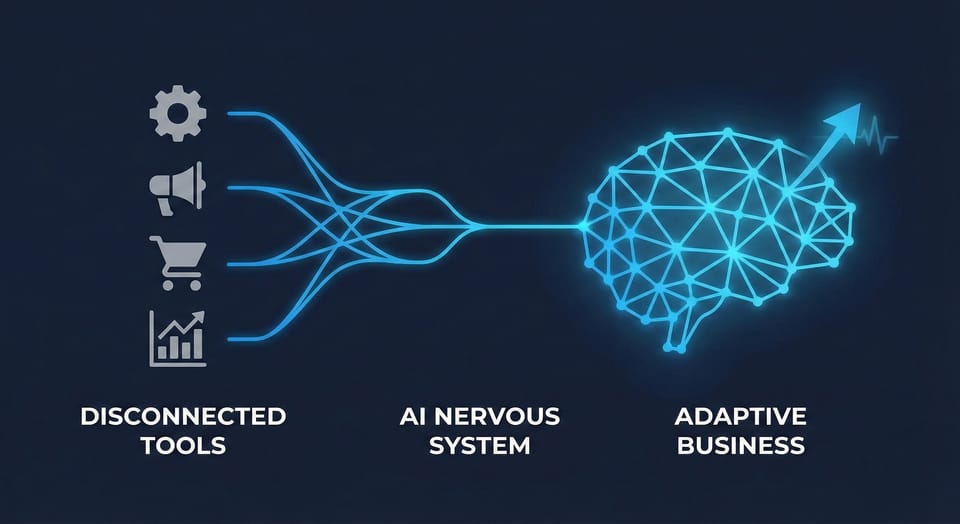
When I first started working with e-commerce brands, I thought the problems would be pretty straightforward.
Better emails.
Better campaigns.
Better funnels.
Better conversions.
And yes — those things matter. They always will.
But after being inside multiple businesses, something else slowly became impossible to ignore.
On the surface, every brand looked different.
Different products. Different audiences. Different team sizes. Different tools.
But underneath, they behaved almost identically.
And what they were struggling with had very little to do with marketing.
The patterns you only see when you zoom out
Every brand had tools.
Shopify. Klaviyo. CRMs. Support platforms. Analytics dashboards. Spreadsheets. Slack. Notion. Automations.
And yet…
Decisions were still manual.
Knowledge lived in people’s heads.
Teams were constantly reacting instead of regulating.
The same problems kept resurfacing in new forms.
Growth increased chaos instead of stability.
That was the first big shift for me.
I stopped seeing brands as “funnels and channels.”
I started seeing them as systems.
And like most poorly designed systems, they lacked:
- clear feedback loops
- real-time awareness
- internal memory
- and mechanisms for self-correction
In systems theory and cybernetics, this is the difference between a machine that just runs — and a system that can sense, learn, and adapt.
Most e-commerce businesses are very good at running.
Very few are built to adapt.
When AI entered the picture
When AI became mainstream, I was genuinely excited.
Because for the first time, we had technology that could actually:
observe
connect
interpret
learn
and respond inside complex environments.
In other words: something cybernetics has been talking about for decades.
But what I mostly saw instead was this:
AI writing more emails.
AI generating more content.
AI replying faster to tickets.
AI producing more output.
Useful? Yes.
But from a systems perspective, almost irrelevant.
It was optimization of surface activity — not improvement of the system itself.
Faster reactions, same blind spots.
What frustrated me
E-commerce doesn’t suffer from a content problem.
It suffers from a control and coordination problem.
Too many disconnected subsystems.
Too many decisions without feedback.
Too much knowledge trapped in individuals.
Too few mechanisms that turn data into regulation.
In cybernetics, a viable system needs feedback, memory, and the ability to adjust its behavior based on what is actually happening.
Most brands have dashboards.
What they don’t have is cybernetics.
They see numbers — but the system doesn’t respond.
So humans become the feedback loop.
Humans become the processors.
Humans become the glue.
Which is exactly why brands become fragile as they grow.
The shift in how I started seeing AI
At some point, my perspective changed.
I stopped seeing AI as a tool you “plug in.”
And started seeing it as something closer to a nervous system for the business.
Not a copywriter.
Not a chatbot.
But a layer that can:
- connect subsystems
- detect patterns
- preserve organizational memory
- support regulation and decision-making
From that moment, my work started changing too.
Less “let’s optimize this channel.”
More “let’s redesign how this system senses, decides, and adapts.”
That’s when AI stopped being about productivity.
And started being about viability.
What I think the next generation of e-commerce looks like
The brands that will win won’t be the ones using the most tools.
They’ll be the ones that behave like well-designed systems.
Businesses with:
real feedback loops
distributed intelligence
embedded memory
and adaptive operations
Where growth doesn’t increase chaos.
Where scale doesn’t depend on heroics.
Where insight flows through the system instead of stopping in dashboards.
Where AI is not a marketing trick — but part of how the business maintains stability, learns, and evolves.
Why this matters to me — and to FirstX
FirstX exists because I don’t believe e-commerce brands mainly need “better marketing.”
They need better systems.
Better structure.
Better coordination.
Better feedback.
Better internal intelligence.
AI is not the point.
Designing businesses that can remain coherent, adaptive, and stable as they grow is.
Not theory.
Not hype.
But real patterns, from inside real systems.
Member discussion